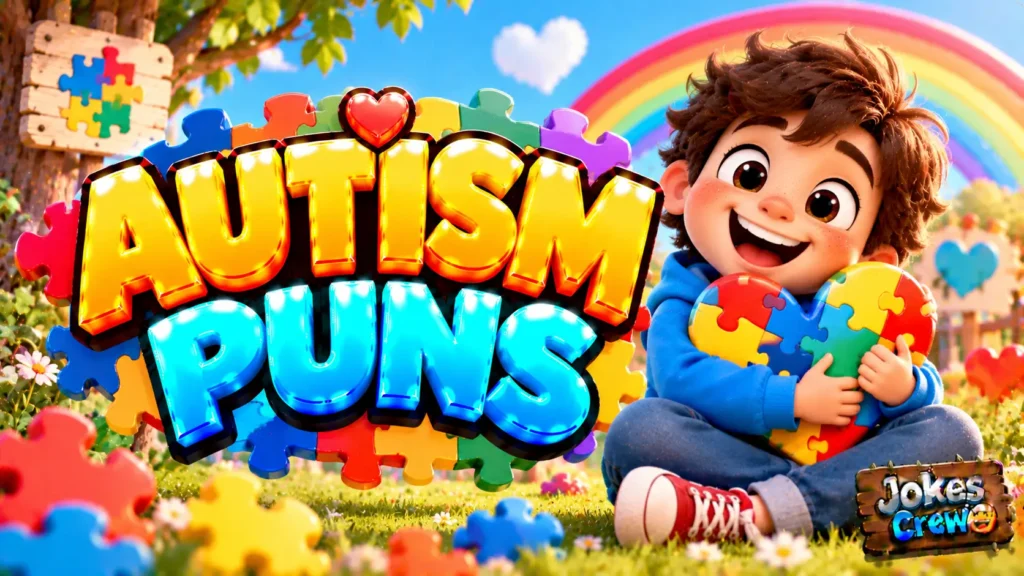
Autism puns can turn everyday observations, clever wordplay, and familiar experiences into moments of shared laughter. From literal language jokes to playful lines about routines and favorite interests, a well-timed pun can make a message more memorable.
This collection includes funny autism puns, short one-liners, captions, friendship jokes, school humor, and positive messages about neurodiversity. Autism experiences and humor preferences vary from person to person, so choose the lines that fit your voice and audience. The goal is to laugh together, not make autistic people the punchline.
Table of Contents
Autism Puns for Word Lovers 🗣️
Language itself can be a wonderful source of comedy. These autism puns lean into definitions, double meanings, punctuation, and the little details that make words interesting. Enjoy them as wordplay rather than assumptions about how every autistic person thinks.
My favorite puns have a double meaning and a single explanation.
Wordplay is my love language; footnotes are my second dialect.
I met a homonym, and we had the same name but different meanings.
A good pun is a sentence taking the scenic route between two meanings.
My dictionary and I are on speaking terms, with definitions in writing.
I don’t split hairs; I alphabetize them.
That pun was so precise it came with a glossary.
I asked for a synonym for “excellent.” The thesaurus gave me a whole roster.
I enjoy a well-structured joke; the punchline must align with the outline.
I don’t overthink words; I give each syllable its own meeting.
The word “fine” has too many meanings. Please select one from the dropdown.
The best puns make sense on two levels and take up one line.
I like an inside joke as long as the entrance is clearly marked.
My favorite punctuation mark is the semicolon; it connects without taking over.
A pun walked into a dictionary and found itself in good company.
I proofread my jokes because the punchline deserves correct spelling.
My vocabulary is expanding; the words are taking up more space.
I appreciate precise language; vague words leave me with loose ends.
My sentence had a great point, but the comma made it pause.
I tried telling a joke about context, but it didn’t know the room.
The best wordplay doesn’t need to shout; it needs the right emphasis.
My dictionary always has a definition for itself. Talk about self-reference.
I enjoy a pun that sticks the landing and spells it correctly.
I like my humor like my instructions: clear, direct, and properly labeled.
The word “literally” is doing a lot of work; somebody should log its overtime.
For more clever combinations and double meanings, explore our collection of word puns.
Literal Language and Logic Puns 📖
Expressions such as “break the ice” and “think outside the box” can sound very different when you picture them literally. These jokes play with familiar phrases and logic, without assuming that every autistic person interprets language in the same way.
Someone said “break a leg” before the show, so I asked whether the venue had first aid.
“Think outside the box” is easier once we agree on the box’s dimensions.
I was told to follow my dreams; they turned left at the coffee shop.
“Keep an eye out” sounds like a very specific storage instruction.
“Read between the lines” would help if the lines came with labels.
I took “take your time” literally and brought a stopwatch.
Someone said “hit the road,” so I asked the road for permission first.
“Speak your mind” sounds like an excellent podcast title.
I heard “piece of cake” and wondered who was cutting the rest.
“On the same page” is my favorite meeting goal; page numbers are welcome.
I tried to let it go, but nobody specified where it should go.
“Put your best foot forward” raises questions about which foot has the best résumé.
“Get a grip” is useful advice if someone can recommend the right size.
I was told to take a step back; now the dance floor is crowded.
“Break the ice” should come with a warning about slippery floors.
Someone said “time flies”; I asked whether it had filed a flight plan.
“Let’s circle back” sounds like a meeting with excellent geometry.
I heard “keep your chin up” and checked the ceiling height.
“The ball is in your court” is a strange way to run an email thread.
“Give me a hand” feels easier when the request comes with context.
“To make a long story short” is a phrase that usually arrives with extra chapters.
“I see what you mean” is lovely; please tell me where to look.
“Think on your feet” is good advice unless you’re already sitting.
The idiom said “go with the flow,” so I asked for the flowchart.
A clear metaphor is like a signpost: helpful when it points somewhere.
Autism Puns About Routines and Planning 📅
Planning can be helpful, and a well-organized checklist can turn a busy day into a manageable one. These jokes poke gentle fun at calendars, advance notice, and the surprisingly complicated business of making a plan.
My schedule has a routine, and the routine has a schedule.
I made a backup plan for my backup plan; now the backups are networking.
Spontaneity is welcome. Please send the agenda in advance.
I like surprises when they’re announced as “surprises” on the calendar.
My checklist has a checkbox for celebrating the finished checklist.
I color-code my plans so even my plans can see the light.
My calendar and I have a standing appointment to check the calendar.
I didn’t get lost; the route took an unscheduled subplot.
My Plan B has a Plan C and a very organized binder.
The schedule changed, and my brain requested the meeting minutes.
I enjoy flexible thinking with clearly marked boundaries.
My to-do list is so organized it started delegating.
I packed early so my suitcase wouldn’t spring a last-minute question.
My routine isn’t rigid; it’s a well-rehearsed dance with a set list.
I scheduled free time, and now it has a calendar invitation.
The plan said “easy day,” so I asked for the actual instructions.
My backup alarm has a backup alarm, and both judge the snooze button.
I don’t resist a change; I prefer it in a clearly named folder.
My timeline has a timeline because even deadlines need boundaries.
I rehearse the plan so the plan doesn’t have to improvise.
A checklist isn’t controlling; it’s a tiny yes-or-no committee.
I brought an itinerary to the free-form event.
My favorite kind of plot twist is one with a table of contents.
My routine has enough contingency plans to run a small airport.
I agreed to “play it by ear,” but I’d prefer sheet music.
Need more general humor for any occasion? Our funniest puns collection has plenty of wordplay to explore.
Sensory-Friendly Humor and Quiet Space Puns 🎧
Sensory preferences differ, but noise, lighting, smells, and textures can matter a great deal to some people. These lines turn comfort tools and clear boundaries into gentle humor, without treating sensory needs as something to ridicule.
My headphones are a sound investment.
I like my lights dim and my expectations clearly stated.
This room has a soft landing for both ears and elbows.
My sensory toolkit has more options than my streaming menu.
I prefer volume on a dial, not as a surprise guest.
The quiet room is my favorite place to turn down the noise, not the fun.
My comfort hoodie is a wearable calm-puter.
Bright lights keep trying to steal the spotlight.
A sensory-friendly plan has all the right settings.
I picked the quiet table because peace was on the menu.
My noise-canceling headphones have a great track record.
The clothing tag was brief, but its career in irritation was long.
My ideal party has snacks, clear directions, and a quiet corner with a nameplate.
I love a dimmer switch; it’s the light of my life.
The blender is loud enough to have its own opening act.
My personal space has a very good boundary policy.
The scent was so strong it needed to take a step back.
My room’s vibe is low volume and high comfort.
The crowded room gave my brain too many tabs to close.
My sensory breaks are a little pause with a big effect.
I like a calm corner; it’s where my thoughts can park.
The fluorescent light was in a bright mood, so I dimmed the conversation.
My favorite sound setting is “I can hear myself think.”
Comfort is not an extra; it’s part of the main design.
I turned down the noise and turned up the afternoon.
Autism Puns About Special Interests and Deep Dives 🔎
Getting deeply interested in a subject can lead to wonderful discoveries, memorable facts, and conversations that last much longer than expected. These jokes celebrate enthusiasm, detailed research, collections, and the joy of following a curious thought wherever it leads.
I said “one quick fact” and accidentally opened a three-part lecture.
My hobby has its own index, glossary, and holiday calendar.
My browser tabs have formed a special-interest neighborhood.
I don’t go down rabbit holes; I build a research station at the entrance.
My curiosity doesn’t wander; it takes guided tours.
The deep dive was so deep it needed scuba certification.
I can explain my favorite topic with citations and a snack break.
My fun fact has a sequel, a prequel, and director’s commentary.
My collection is carefully curated and emotionally well-referenced.
I know a surprising amount about this topic; the surprise wears off around hour two.
My bookshelf is a fan club with page numbers.
I came to share one detail and stayed to establish a timeline.
My presentation has backup slides for the backup slides.
My enthusiasm comes with footnotes.
I didn’t memorize trivia; it simply moved in rent-free.
My interest has become a long-running series with no cancellation date.
I checked one source and found six more doing a group project.
My mind has a favorite topic, and it has a preferred seat.
My notes are so detailed the details have their own notes.
I organized my collection and achieved peak shelf-esteem.
I call it a deep dive; my friends call it a documentary with audience participation.
Every question is an invitation to open another tab.
My hobby’s FAQ now needs an FAQ of its own.
I can spot a tiny detail from a mile away, especially when it relates to my favorite thing.
I don’t just learn a subject; I read the bonus content.
Autism Puns About Communication and Friendship 💬
Clear communication can make friendships easier and reduce the guesswork in everyday situations. These puns celebrate direct language, thoughtful listening, and the little things that help people understand one another.
Clear communication is important because mind-reading shouldn’t be a team requirement.
I like hints when they arrive with captions.
Say what you mean; my brain appreciates a direct delivery.
Our friendship has no hidden clauses, only visible subtitles.
A good conversation has room for silence and a clear ending.
I prefer honest words over a guessing game with invisible rules.
My text message is a carefully edited first edition.
“We need to talk” needs a subject line and a meeting purpose.
I appreciate a friend who labels a joke when the joke needs a label.
My calendar invitation says “socialize”; I asked what the agenda includes.
Our group chat has more context than most mystery novels.
A good friend understands that a pause is not a deleted friendship.
I don’t need perfect timing; a little clarity keeps things in sync.
My conversation starter has a user guide and two sample questions.
The best listener is the person who lets me finish the sentence.
I can do small talk, but I prefer small talk with a clear exit.
My friends speak fluent honesty and beginner-level ambiguity.
A thoughtful check-in is a message with excellent delivery.
I appreciate a plan that tells me who, where, when, and the snack situation.
We don’t always share the same wavelength, but we can adjust the volume.
A true friend makes room for different ways to communicate.
My favorite conversation has no pop quiz at the end.
I like my boundaries like my directions: easy to find and respected.
A good friendship comes with subtitles for misunderstandings.
Asking for clarification isn’t a plot twist; it’s collaboration.
Positive Autism Puns About Acceptance and Neurodiversity 🌈
Celebrating neurodiversity means recognizing that people have different needs, perspectives, communication styles, and ways of participating in the world. These encouraging puns use wordplay about settings, design, voices, and belonging to keep the message warm and memorable.
Different wiring, same right to pick the Wi-Fi password.
Inclusion is an open door, not an escape room with hidden rules.
There is no single setting called “normal”; explore the full options menu.
Accessibility is good design that knows how to make room, not a welcome mat over a locked door.
Acceptance isn’t a pop quiz; belonging doesn’t need a passing grade.
Different minds bring different angles, so the world gets a better point of view.
Respect doesn’t need a manual, but it does need regular practice.
A welcoming space doesn’t force every brain to use the same operating manual.
My point of view isn’t a glitch; perhaps the frame needs adjusting.
Neurodiversity means there’s more than one way to think outside the box, and more than one way to build it.
Good support fits the person; it doesn’t make the person fit the template.
Belonging doesn’t come with an entry exam or a trick question.
Accommodation is a small change with a very big welcome mat.
When everyone gets a voice, the conversation upgrades without muting anyone.
Respect isn’t a universal remote; one button won’t work for every person.
No one is a checkbox; people come with whole stories and bonus chapters.
Different brains don’t just change the angle; they bring extra lenses.
Inclusion isn’t a bonus feature; it’s part of the basic package.
There’s more than one route to a great day; no one should be graded on the detour.
The spectrum of human experience doesn’t fit in one tiny dropdown.
Make room for difference, or the world becomes an echo chamber with bad acoustics.
Listening isn’t a downloadable add-on; it comes with respect.
Support should be tailored, not copied from a one-size-fits-all printer.
A world designed for more people has fewer “sorry, that’s not supported” screens.
Kindness speaks many dialects, and everyone deserves a turn with the microphone.
For a few more upbeat lines to share with someone who could use encouragement, see our motivational puns collection.
Autism Puns for Captions and Self-Expression 📱
A social media caption can be a small way to express personality, share an everyday moment, or celebrate a preferred way of doing things. These lines are written in a personal voice, so use or adapt the ones that feel right for you.
My brain has a favorite tab; it also has a tab-management committee.
Autistic, enthusiastic, and here for the details.
No one-size-fits-all, just my own settings.
My social battery has a charging dock and clear hours.
Headphones on, boundaries clear, day underway.
I came for the topic and stayed for the footnotes.
Today’s forecast: clear communication with a chance of deep dives.
My version of small talk comes with a table of contents.
Not a glitch, just a different interface.
My sensory toolkit is part of the fit, not a fashion accessory.
I’m on a roll, but please label the roll.
Main-character energy, subtitles included.
My comfort zone has a good map and accessible exits.
I don’t do hints without the hint manual.
My kind of social event has an agenda and a quiet corner.
Neurodivergent perspective: one more lens for the big picture.
My interests have range and excellent indexing.
Direct is my favorite dialect.
On the spectrum of playlists, this one is a precise match.
I brought my own rhythm; the beat is optional.
My calendar says yes, but my energy would like a consultation.
The details aren’t small to me; they’re the main attraction.
I don’t do mystery instructions; I’m here for the director’s cut.
Caption this: a day with no hidden rules.
My settings are personal, not defaults.
Need a thank-you note or a celebratory message to go with a caption? Our birthday card puns collection offers more ways to make a message memorable.
Autism Puns for School, Work and Everyday Life 🎒
Classrooms and workplaces run more smoothly when directions are clear and people can use the communication and support that work for them. These jokes mix school supplies, deadlines, meeting habits, and teamwork with a little practical humor.
Meetings go better when the agenda doesn’t play hide-and-seek.
My workflow works best when the work comes with a flowchart.
Group-project tip: divide tasks, not assumptions.
Clear instructions are both an accommodation and a productivity upgrade.
The deadline was vague, so I asked it to define itself.
My email isn’t blunt; it’s efficiently punctuated.
I take breaks before my brain’s browser freezes.
An accessible classroom lets every learner choose a route to the answer.
The assignment said “use your imagination,” so I requested examples.
My presentation had alt text and excellent intentions.
My supervisor said “circle back,” so I sent an actual calendar invitation.
My desk setup is an exercise in thoughtful ergonomics.
The best team makes sure different communication styles don’t get lost in translation.
My working memory needed a second monitor.
I use checklists because my brain deserves better than a guessing game.
Classroom rules work better when they’re written, not whispered into folklore.
The office quiet room is the real executive suite.
I told the class to think outside the box, then supplied a box diagram.
An inclusive group project shares the instructions before the panic.
Good feedback is specific enough not to need a decoding ring.
My task list doesn’t procrastinate; it queues.
The deadline moved, and the plan asked for a map.
Clear meeting notes are like captions for conversations.
The learning environment got a software update: more access, fewer assumptions.
A supportive teacher doesn’t make every brain follow the same route.
For more family-friendly wordplay and classroom-friendly jokes, browse our kid puns collection.
FAQs About Autism Puns 📝
Autism puns are playful lines that use wordplay, literal expressions, routines, communication, or neurodiversity-related experiences to create humor. The best ones are respectful and avoid reducing autistic people to stereotypes.
It depends on the joke, the audience, and the situation. Many people enjoy humor about their own experiences, while others may dislike particular terms or jokes. Use the language someone prefers and avoid making a person the target of unwanted humor.
Try “Not a glitch, just a different interface,” “My social battery has a charging dock,” or “My interests have range and excellent indexing.” Choose a line that feels authentic to your own experience.
Yes, when the humor is inclusive and appropriate for the students involved. Avoid jokes that single out a student or imply there is one correct way to communicate, learn, or participate. Keep instructions and support clear.
Laugh with people rather than at them, avoid stereotypes, and remember that autism experiences vary widely. When writing about a specific person, follow their preferences about identity-first or person-first language and ask before sharing personal details.
No. Humor preferences vary among individuals, just as they do among non-autistic people. Some enjoy puns and literal jokes, while others prefer different styles of comedy or simply don’t like a particular joke.
Conclusion 🌈
Good autism puns make room for different personalities, perspectives, and ways of communicating. Whether you choose a clever caption, a literal-language joke, or a playful line about planning, the best humor brings people together without asking anyone to hide who they are.
Oliver lives by a simple rule: life is too short to take seriously, but never too short for a cheesy pun. Whether he's digging up goofy animal jokes, coffee puns, or random dad jokes, his ultimate goal is to make you groan, smile, and question his life choices. When he’s not writing, he’s probably testing terrible jokes on unsuspecting friends.